Showing posts with label Planetary Boundaries. Show all posts

Saturday, May 5, 2012

Climate Change at the Limits (2)


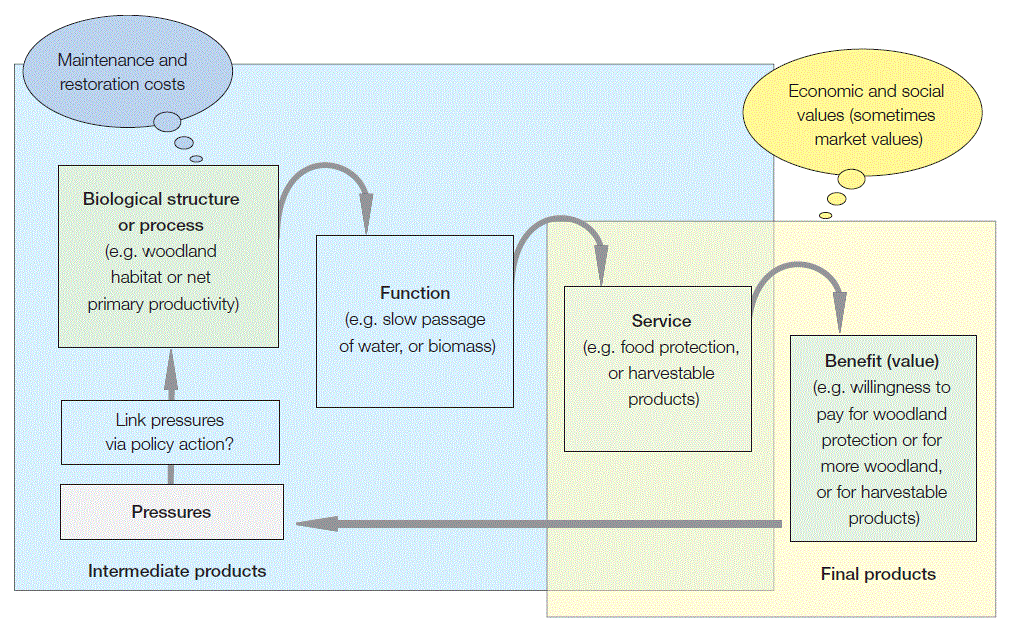
 Source: Roy Haines-Young, presented by J-L Weber, the Global Loss of Biological Diversity, 5-6 March 2008, Brussels 
(From the TEEB Report 2010)

Welcome back to my series of blogs on Planetary boundaries, (as defined by scientists at the Stockholm Resilience Centre) and specifically the 3 boundaries the scientists believe we have already breached.  Last time I looked at Climate Change; this time I’m covering Biodiversity and Nitrogen and Phosphorous inputs to the biosphere and oceans

Biological diversity.  What is biodiversity? Biodiversity is the degree of variation of life forms within a given species, ecosystem, biome, or an entire planet. Biodiversity is a measure of the health of ecosystems. Changes in biodiversity due to human activity have been more rapid in the last 50 years than at any time in human history.  The drivers for change are either steady, show no signs of declining or are increasing.  These large rates of extinction can be slowed by enhancement of habitats and maintaining high agricultural productivity (see “Land use change” in my next blog)

Historically, the main business risk of declining biodiversity and ecosystem services has been to corporate reputations. In recent years, food producers and retailers in particular have been targeted over the damage to ecosystems of their sourcing of certain products or raw materials, such as fish and timber.  However, as global ecosystems show increasing signs of breakdown and stress, more companies are realising how dependent their operations are on the critical services these ecosystems provide. The decline in biodiversity and ecosystems is making natural resources scarcer, more expensive and less diverse – increasing the costs of water and escalating the damage caused by invasive species to sectors including agriculture, fishing, food and beverages, pharmaceuticals and tourism.

Continued degradation of global biodiversity and ecosystem services could increase the pressure on these and other industry sectors. It would add to operational risk and, in certain locations, potentially jeopardise the long-term profitability and survival of some of the most-affected sectors such as forest products, agriculture and fisheries. Companies further up the supply chain or that operate “upstream” may be more susceptible to operational and regulatory challenges, while companies down the supply chain often have a greater degree of public exposure and therefore to potential reputational risks

The KPMG Report mentioned in my last blog refers to the UN initiative, “The Economics of Ecosystems and Biodiversity” (TEEB), which estimates that the value of avoided greenhouse gas emissions from conserving forests is US$3.7 trillion, while insect pollinators contribute US$190 billion a year to agricultural output.

While agriculture could drive an increase in deforestation, due to increasing demand for food, industries that depend on biodiversity for innovation, such as pharmaceuticals, could suffer from continued primary forest loss and have an incentive to prevent it.

Nitrogen & Phosphorous – human impact on the nitrogen cycles has been even greater than on the carbon cycle.  It takes 5% of the total annual global energy production, for companies to create the nitrogen needed for the world’s food production. A small proportion of the fertilizers applied to food production systems is taken up by plants, but 85% is wasted and never absorbed, directly contributing to the greenhouse gas effect.  It also leeches into the soil, polluting waterways and coastal zones. 

Fertilizer manufacturing companies use a strip mining process to mine non-renewable bulk raw phosphate. Then using volatile and harmful chemicals and acids (sulphuric acid), they transform the bulk mined material into phosphorous which is then used in fertilizers..

If an excess of phosphate enters the waterway, algae and aquatic plants will grow wildly, choke up the waterway and use up large amounts of oxygen.  This rapid growth of aquatic vegetation eventually dies and as it decays it uses up oxygen. This process in turn causes the death of aquatic life because of the lowering of dissolved oxygen levels.

A significant fraction of the applied nitrogen and phosphorous makes it way to the sea and can push marine systems across thresholds of their own.

As mentioned by Sustainable Agritech, the vital roles nitrogen and phosphorous play regarding plant development is understood.  Without them, the people of the world today would quite literally starve to death. They feel that by strengthening “best management practices” and incorporating Sea-Crop - a natural source balanced formula from ocean water that has all the natural elements known to man and which helps develop healthy and energetic plants - our food supply would be more nutrient dense.  This will allow the world’s population to have more mineral and vitamin rich fruits, vegetables and in some cases meats to help them to remain healthy and more resistant to disease.

Next time I’ll be looking at those boundaries which the Scientists at the Stockholm Resilience Centre believe we haven’t yet breached, or the boundary is as yet unknown.

Saturday, April 14, 2012

Climate Change - At the Limits

Image courtesy of www.nature.com

Following on from my blog on Resource Scarcity and in preparation for my PCBS which started at Cambridge last week, I have been reading the work of 28 internationally renowned scientists on Planetary Boundaries.  This may sound a bit heavy, but please hang in there!  It’s taken me a couple of weeks to get my head round the content and will form a total of 3 blogs, but I’m hoping this blog will provide a useful summary.

The planetary boundaries approach focuses on the “services” provided via Earth’s systems.  In contrast to other approaches, this approach identifies environmentally safe boundaries within which to operate and accounts for non-linear change due to the crossing of a threshold.  Even though the Earth’s “services” are directly linked to human welfare, they are not easily captured in a typical risk assessment. 

The work on planetary boundaries is a first step, identifying biophysical boundaries at the planetary scale; (in contrast to piecemeal (or individual) commitments made by individual countries); within which humanity can choose numerous routes to human well-being and development.  Katherine Richardson (co-author and one of the 28 scientists) emphasises the huge potential for mankind to be more proactive.  The authors highlight the fact that further work will need to focus on the societal dynamics that have led to the current situation and propose ways in which our societies can stay within these boundaries.  However, Richardson believes their work presents a framework for use in the societal decision making process.

Crossing the Boundary

Nine global biophysical boundaries were identified, three of which the scientists believe we’ve already crossed.  These are climate change, biological diversity and nitrogen input to the biosphere.

In this blog I will address the first of the three boundaries which we have already breached and why I believe we should care.  In subsequent blogs I will address the remaining boundaries and their impact.

On climate change, the scientists at the Stockholm Resilience Centre report that we’ve reached a point at which the loss of summer polar ice is almost certainly irreversible.  There is melting of almost all mountain glaciers around the world and an increased rate of sea-level rise in the last 10-15 years.  The “Carbon Sinks”, like forests, that capture carbon are also reducing.  (The area covered by primary forests – those undisturbed by human activity – has fallen by more than 40 million hectares, an area larger than Germany or Japan, since 2000). 

An article by Jonathan Amos, Science Correspondent for the BBC reports on a new detailed record of past climate change, (by a Harvard University-led team), that proves the last ice age was ended by a rise in temperature driven by an increase in atmospheric carbon dioxide.  The Scientists from the Stockholm Resilience Centre also refer to the four-degree latitude poleward shift of subtropical regions, which contributes to increasing aridity in the Mediterranean region, the southern US, eastern Australia and parts of Africa, the increased bleaching and mortality of coral reefs, driven in part by ocean acidification and rising sea surface temperature, an accelerating rate of sea-level rise in the last 10-15 years and a rise in the number of large floods.

The Impact 

Carbon and ecosystem service-intensive industry sectors such as energy, heavy industry and agriculture are likely to face increasing regulatory and consumer pressures to reduce their impact. At the same time, “clean technologies” such as renewable energy are likely to be among the biggest industries of the future. Consider these figures:

·        In 2008, the world’s 3,000 largest public companies by market capitalization were estimated to be causing US$2.15 trillion of environmental damage, equivalent to 7 percent of their combined revenues and 50 percent of their combined earnings

·        Predictions of annual output losses from climate change range between one percent per year, if strong and early action is taken, to at least five percent a year if governments fail to act.

·        The Carbon Disclosure Project reported this year that companies with a strategic focus on climate change provided investors with approximately double the average total return of the Global 500 from January 2005 to May 2011.

However, it is developing countries and the businesses that operate in them that are most vulnerable to climate change impacts even as their rapid industrialization increases their contribution to global CO2 emissions

·         Sea level rises could cause flooding in low-lying coastal areas, displacing “tens to hundreds of millions of people” in places such as Southeast Asia, particularly Bangladesh and Vietnam, and small Caribbean and Pacific islands. It is believed that some of the world’s largest and richest cities, such as Tokyo, New York, London and Shanghai could also be affected.  Here's one example of business impact from Toyota, resulting from the floods in Thailand last year.

·        The Association of British Insurers suggest that, as a result of an inevitable 2 degrees C temperature change, the average annual insured loss in the UK from inland flooding will increase from £47m to £600m.

The CDP Report highlights that some of the most significant effects in the UK will result from Climate Change elsewhere in the world, in the global supply chain.

I hope you’ve found this useful and look forward to catching up with you next time on the breach of the global biodiversity boundary and its impact.